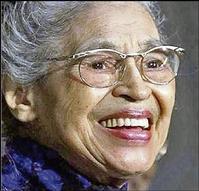
Rosa Parks smiles at a Capitol Hill ceremony on June 15, 1999, where she was honoured with the Congressional Gold Medal. - CONTRIBUTED
DETROIT (AP):
FORMER UNITED States president Bill Clinton yesterday remembered the late civil rights icon Rosa Parks as "a woman of great courage, grace and dignity."
He said she was an inspiration to himself and "to all who work for the day when we will be one America."
Rosa Parks, whose refusal to give up her bus seat to a white man sparked the modern U.S. civil rights movement, has died at age 92.
Mrs. Parks died on Monday at her home of natural causes, with close friends by her side, said Gregory Reed, an attorney who represented her for the past 15 years.
Mrs. Parks was 42 when she committed an act of defiance in 1955 that was to change the course of American history and earn her the title "mother of the civil rights movement."
At that time, segregation laws in place since the post-Civil War Reconstruction required separation of the races in buses, restaurants and public accommodations throughout the South, while legally sanctioned racial discrimination kept blacks out of many jobs and neighbourhoods in the North.
The Montgomery, Alabama, seamstress, an active member of the local chapter of the National Association for the Advancement of Coloured People, was riding on a city bus December 1, 1955, when a white man demanded her seat.
JAILED AND FINED
Mrs. Parks refused, despite rules requiring blacks to yield their seats to whites. Two black Montgomery women had been arrested earlier that year on the same charge, but Mrs. Parks was jailed. She also was fined $14.
U.S. Rep. John Conyers, in whose office Parks worked for more than 20 years, remembered the civil rights leader Monday night as someone whose impact on the world was immeasurable, but who never saw herself that way.
"Everybody wanted to explain Rosa Parks and wanted to teach Rosa Parks, but Rosa Parks wasn't very interested in that," the Michigan Democrat said. "She wanted them to understand the government and to understand their rights and the Constitution that people are still trying to perfect today."
Detroit Mayor Kwame Kilpatrick said he felt a personal tie to the civil rights icon: "She stood up by sitting down. I'm only standing here because of her."
Her arrest triggered a 381-day boycott of the bus system organised by a then little-known Baptist minister, the Rev. Martin Luther King Jr., who later earned the Nobel Peace Prize for his civil rights work.
"At the time I was arrested I had no idea it would turn into this," Mrs. Parks said 30 years later. "It was just a day like any other day. The only thing that made it significant was that the masses of the people joined in."
The Montgomery bus boycott, which came one year after the Supreme Court's landmark declaration that separate schools for blacks and whites were "inherently unequal," marked the start of the modern civil rights movement in the United States.
The movement culminated in the 1964 federal Civil Rights Act, which banned racial discrimination in public accommodations.
After taking her public stand for civil rights, Mrs. Parks had trouble finding work in Alabama. Amid threats and harassment, she and her husband Raymond moved to Detroit in 1957. She worked as an aide in Rep. Conyers' Detroit office from 1965 until retiring in 1988. Raymond Parks died in 1977.
Mrs. Parks became a revered figure in Detroit, where a street and middle school were named for her and a papier mâché likeness of her was featured in the city's Thanksgiving Day Parade.
Mrs. Parks said upon retiring from her job with Conyers that she wanted to devote more time to the Rosa and Raymond Parks Institute for Self Development. The institute, incorporated in 1987, is devoted to developing leadership among Detroit's young people and initiating them into the struggle for civil rights.