Mario James, Contributor 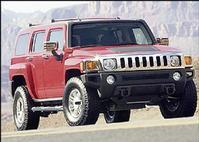
2005 Hummer H2.
WE JAMAICANS sometimes adopt concepts, principles and ways of doing things that do not reflect our unique environment. Case in point, SUVs (Sport Utility Vehicles). Conveyances like this are, essentially, an American invention, and on paper, they seem like a good idea; four-wheel drive, more space than you can stick a sheet of ply in and, supposedly, a car-like ride. And let's not forget the safety issue. But who really comes out the winner here? The Jamaican consumer, or foreign capitalism?
The SUV craze started when the Ford Bronco II became the Explorer (some might say that the Dodge Caravan started it, but the Caravan wasn't available with four-wheel drive). The Explorer was the first true mass produced SUV, available with body on frame construction,
4.0 litre V6, part-time four-
wheel drive with low range
gearing available, four doors
and a cavernous interior, twin beam independent front suspension and a good ol' live axle bringing up the rear . It is still the best selling SUV in America, because they stuck to a formula; BIG means prestige, so SUVs got bigger an' bigger.
The thing is, because of the burgeoning market, and thanks to economies of scale, the bigger they got, the more they sold (that prestige thing); the more they sold, the lower the actual production cost was. But manufacturers sold them with record mark-ups. The populace can't seem to get enough of SUVs; they are the most profitable
auto-market niche right now.
But of all automotive products, SUVs are the least expensive to produce. Wanna know why?
LIVE AXLE
Most SUVs (at least the ones that do well in America) are sold with suspension technology that was around since the horse and carriage. Elliptical leaf springs and the straight axle (heretofore referred to as a 'live axle' set-up) adorn the rear end of 95 per cent of all SUVs. This technology
has long been superseded by independently suspended
suspensions, yet they doggedly refuse to die under the wheel arch of change. Most car-makers have tried-and-true old tech suspension elements designed from the sixties and seventies, and they just chuck them under these new products because they don't have to do research and development on them. Big savings, that.
The typical SUV is also a
big boxy brute; little or no wind tunnel testing is done on them, because they have to be perceived as big, strong, macho type vehicles that can take its driver to the country club and swing by that forested creek for fishing (notable exceptions to this are the M-Class Mercedes and the BMW X5). And, also because of the archaic suspension, most SUVs have a jarring, back-breaking ride over the rough stuff. On pavement, the weight of the vehicle dampens out the ride. Range Rovers have a novel, air suspended body, but so far this fickle market will not pay for such fine engineering.
THE BIGGER THE BETTER
Unibody vehicles have been around since the 1960s; the term references a type of body construction that does away with units that have a separate chassis. Engineers refer to a body built this way as a monococque design. It was, and still is, the way to build a race car. But it costs a lot to design; usually, stress analysis for a car utilising this method has to be done on a supercomputer, and that's expensive. So SUVs have a ladder frame that the body bolts to. Very cheap, and it has worked for the past century or so.
However, there is an inherent weakness with the separate frame format; it does not resist twisting forces very well at all, and these forces are encountered when one goes off road. Engineers trying to make the archaic suspension work have even bigger headaches because of the torsional twisting that seems to plague this technology. But the masses don't know, and don't seem to care. The formula for the past 10 years has been: make it big and boxy, so that over-compensating weenies will buy it; throw enough interior luxuries at it until inside looks like a room at the Ritz-Carlton, and sell it for around US$40,000 (even though it rides like a Mack truck) then sit back and watch the dough roll in.
Independent four-wheel drive suspensions are hard to design, and hard to make. Heavy unsprung weight components (suspension pieces and wheels
'n' tyres) and friction are the bane of proper suspension design. Yet these undesirables abound in SUV suspensions. SUVs burn a lot of gas because they are so big, they have a lot of air to move out of the way. And to contain so much space they have to be heavy. Compounding all of this, they couple them to engines that are small and
struggle to cope with the mass.
SAFETY ISSUES
Safety is also an issue. The consumer might feel that in a collision with a smaller vehicle, the oversized SUV would win. And he'd be right. But in a
collision with a larger one, the SUVs ladder frame construction has very little give. In these
accidents, the occupants of these road behemoths tend to come
out the loser because there is no energy dissipation; organs start bouncing around in rib cages and craniums and people get hurt.
Who really wins here? The manufacturers in this market segment have a niche that's under-informed, into bling an' ting and style and fashion, not what really matters So they dress up old engineering and pass it off as new. Not all that glitters is gold, folks. We need to make better consumer-based decisions; a decision made based on style alone is not usually a good one, be it clothes, a mate or buying a car. Inform yourselves. Do the research before stepping up to the plate.


















