- FILE
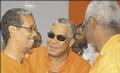
Prime Minister P.J. Patterson (right ), Paul Burke, former Region Three chairman (left) and Robert Pickersgill, Minister of Transport and Works in discussion at the People's National Party's annual conference at the National Arena on Saturday, January 22.
Arnold Bertram, Contributor
PAUL BURKE'S eleventh-hour nomination for the PNP's vice-presidential race reflects a strategic decision by the political camp of presidential hopeful Omar Davies, to create an opening for their candidate who has so far failed to make an impression within the party.
The reliance of Davies on Burke is not new since it was Burke who facilitated his elevation to the chairmanship of Region Three two years ago. It is this emerging alliance which provides the basis for the boast from the politically naive around Davies that after February 5 Peter Phillips' candidature will be sabotaged beyond recovery. The more experienced, however, harbour no such illusions.
Burke's entry makes it no longer possible to return the existing four vice-presidents en bloc. Elections will now be held with five contenders in the race. Given the legal requirement of each voter to select four candidates on each ballot, the Davies' camp can use their seemingly unending resources to convince Blythe's and Simpson's supporters to drop Phillips from their slate in favour of Burke.
POLITICAL SNIPERS UNLEASHED
This manoeuvre allows Davies to keep himself out of the line of direct political fire, even as political snipers are unleashed to take aim at Phillips, to make sure that he comes lower than his second-place finish in the last elections. They reckon that the public,, unaware of the internal politics, will come to the view that Phillips no longer enjoys the tremendous support which was on show at his 'mini launch' a week ago.
This strategy seems clever, but dangerously underrates the seriousness with which members of the PNP approach the business of the party.
However, the public should know that whereas only 1,600 delegates will be participating in this weekend's sideshow, some 4,500 will vote in the presidential elections, whenever it takes place. At that time no manoeuvre will disguise the fact that Phillips leads the main stream of the party membership and moreso than any other contender, enjoys the confidence of his colleagues in the Cabinet and parliamentary group.
The clear message to Davies' handlers is that there is no way around the verdict of the party. Phillips and Davies are at the present time responsible for portfolios most critical to the country's survival and development. Neither can succeed without the other and the entire country is dependent on their combined success.
How then can Davies predicate his elevation on Phillips' demise? Where does Portia Simpson Miller stand in all this?
She could hardly have been amused by Burke's entry into the race since his presence can only undermine her chances of coming first and diminish the popular perception which is so crucial to her political standing.
She knows that to come first she needs not only Davies' resources but more importantly Blythe's and Phillips' votes and it is unlikely that she can count on both simultaneously. What she offers Burke is clear. What Burke offers her is yet to be quantified.
Blythe's situation is even more precarious. If he does the bidding of the Davies camp and supports Burke by excluding Phillips from his slate he might just be giving Burke enough votes to beat him and provide a platform for Davies. He could hardly want such an outcome.
RAN INTO POLITICAL AMBUSH
Secondly, he certainly can't forget the last vice-presidential elections when he ran into political ambush. On that occasion, those who had promised him support abandoned him at the last minute.
Given the scope for opportunism and treachery in the present political situation, Paul Robertson might just turn out to be the winner. For while fewer are enthusiastically for him, he is the only viable candidate without presidential ambitions.
At another level, all that glitters in politics is not necessarily gold as the Davies' camp would have learnt from last week's Conference which they left far less confident and conspicuous than when they arrived.
In politics, hope springs eternal and next weekend, the Davies camp will be making every effort to use the vice-presidential elections to mount another sideshow. They are convinced that their manoeuvre against Phillips will have the effect of a political 'tsunami'. Indications are that this so-called 'tsunami' is rapidly becoming a political 'suicide bomb'