By Orville W. Taylor, Contributor 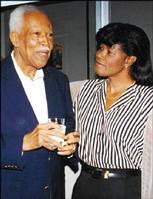
The late Hugh Lawson Shearer and PNP Vice-President Portia Simpson Miller. - File
THE MOST Honourable Hugh Lawson Shearer has left us and immediately there is talk about his official funeral and his ascent into National Hero's status. This is one of the natural things what we do as a society. We try to canonise our dead. There are expressions such as "speak no evil of the dead" which we take as gospel. Thus, on the death of historical figures we sanitise their records and initiate a process of their apotheosis.
I met Mr. Shearer on a number of occasions while I worked as a conciliator in the Ministry of Labour and must confess that I was never overawed by him. True, I was mindful that he was once Prime Minister and that he was part of the history of local and regional industrial relations (not just trade unionism), and at the time president of the then largest trade union in the anglophone Caribbean. (Is it still the largest? Can someone put away the ego and give me an honest estimate?) Yet, I never felt that I had to treat him as a deity or that he required this. The truth is I saw him as a magnanimous man, but a man nonetheless and thus was an imperfect and flawed being, though his yeoman service to trade unionism is without question.
As a researcher I came to place his work and contribution in a more realistic perspective and developed a critical eye for the various contributions to Jamaican labour relations.
In 1967 on the death of Donald Sangster (I actually remember the funeral and the tears I shed) Shearer became Prime Minister and held the reins of government until his defeat in 1972. I was sad to see him lose, as my grandmother has really liked him even though my father was a strong Norman Manley man. His trouncing of Amador Gilman Snr. to maintain his seat was a pleasant small personal compensation.
RECORD
However, on looking at his record as a former trade unionist in the seat of government, the researcher and worker-sympathiser in me (OK, now the JEF people know) had to ask, how come there was no significant pieces of labour legislation passed during the five years of his leadership? It struck me as odd that that Trinidad and Tobago had by 1967 passed an Industrial Stabilisation Act (ISA). This statute gave to the 'Trinbagonians' a formal system of dispute resolution, an industrial court and a process for the compulsory recognition of trade unions. All of these were absent in Jamaica when the PNP won in 1972. Given that we had got our independence a few days before them and we had a labour party in power in every sense of the word, the absence was
egregious.
One recognises that Jamaica was initially part of the West Indies Federation and ostensibly led to its demise in 1961 due to our secession under the leadership of the JLP, with Bustamante, Shearer and Seaga on board. I wondered then whether it was due to some notion of national parochial insularity or some misguided view that there was nothing that we could learn from the leadership of Eric Williams. Did Shearer ignore the example of our Caribbean neighbours as Bustamante misguidedly did earlier? Another question that came to mind was what happened to trade unionists when they
came to power? Is there some dissonance between their need to carry out the wishes of workers and that of the people at large? Can one be an effective politician in power and still remain true to one's trade union roots?
In contrast, Michael Manley, who we also tend to deify, passed a slew of labour legislation in the first five years of his regime. By 1977 he had already enacted at least five statutes including the Labour Relations and Industrial Disputes Act (LRIDA), the centrepiece of our present industrial relations system. Nonetheless, there are at least two sides to every myth and as fate would have it, the LRIDA and the earlier Employment Termination and Redundancy Payment Act (ETRPA) actually began as bills initiated under the JLP Government in 1971. What is even more intriguing is that the PNP and the NWU initially opposed the LRIDA while in opposition. To make it more interesting, when the LRIDA was re-introduced by Manley in 1974 the JLP and BITU objected to much of it as well.
So what does that tell us about politicians and trade unionists? Well, the shoes are worn differently depending on the role of the wearer.
LABOUR RELATIONS
ENVIRONMENT
So, when it comes to the current labour relations environment in Jamaica we can say that both Manley and Shearer are to be credited or blamed for its design. For the past 20 years it has been demonstrated that the labour relations system excludes non-unionised workers, who comprise more than 80 per cent of the employed labour force. As regards the protection of employment it is the worst of its kind in CARICOM in that this is the only place that has an industrial court or tribunal that is not accessible to the average worker. The short-sightedness of both Manley and Shearer was that they did not conceive of aggrieved workers as existing outside of the collective bargaining framework.
However, inasmuch as I critique this flaw in the design of the well-intentioned system the most significant thing that Shearer has done since his return to the ranks of the labour movement was not the formation of the Jamaica Confederation of Trade Unions (JCTU) in 1990.
MAJOR UNIONS
Strangely, it is his role in the failed national strike in 1985. Then he was part of a group of six major unions confronting his Prime Minister while he himself was a sitting Parliamentarian. Of course at the last minute he backed off and the back of the strike was broken. Yet, the lesson this showdown taught us is clear. At a certain point a trade unionist/politician must choose. After the strike Shearer re-defined his role as a trade unionist and not a politician and this continued after the JLP's loss in 1989. True, it is much easier to do when one is in opposition but he taught us an important lesson. The era of political/partisan trade unionism is gone.
Thus in the wake of his death what has he left for us? Unlike the 1960s we do not have the luxury of ignoring the rest of CARICOM as the CSME is coming in a year. There are cracks in the labour management system in Jamaica and these need to be fixed as we integrate into the CSME. Now is also a time for trade unions to not play politics, games of self-aggrandisement and one-upmanship. In light of this last admonition there is a glimmer of hope. Recently one of Shearer's mentees broke ranks with his party and signed a worker-oriented Memorandum of Understanding (MoU).
Maybe they are finally learning something from his human errors.
* Dr. Orville Taylor is a
sociologist at the University
of the West Indies.