By Howard Campbell, Gleaner Writer 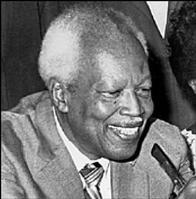
Hugh Lawson Shearer
THE ACHIEVEMENTS of Hugh Lawson Shearer as Prime Minister of Jamaica are usually muted when compared to that of his successors, Michael Manley and Edward Seaga. Some of his accomplishments, including a stable economy and the building of schools, have been hailed since his death on July 5.
Yet, for many people the Shearer years are best remembered for an incident in October 1968 that sparked a day-long riot in Kingston. The Prime Minister barred University of the West Indies lecturer, Walter Rodney of Guyana, from entering the country, a move that did not go down well with students at the Mona campus.
The popular Rodney was a lecturer in the History Department at Mona and had found a strong following on campus and throughout neighbouring August Town with his speeches on black pride. Given Jamaica's conservative setting, Hartley Neita, Shearer's then press secretary, says the Prime Minister took a safety first approach when he prevented Rodney and his family from re-entering Jamaica.
BUILD, NOT DESTROY
"He (Shearer) supported Martin Luther King and Andrew Young and the Civil Rights movement but he did not agree with Black Power because they supported violence," said Neita. "His thing was Black Power was to build not to destroy."
It was the height of the Cold War and several books with left-wing content were banned by the Jamaican Government, a carry-over from the days of British rule. Neita was unable to recall titles of any of the blacklisted books, but says most of them were published in Communist nations such as Russia and China.
Although he was only 26 years old, Rodney had come a far way. Born in Georgetown into a working-class family, he studied at the Mona campus in the early 1960s and taught at the University of Dar-Es-Salaam in Tanzania shortly after graduating.
His Pan-African beliefs grew during his stint in Africa and when he returned to teach at Mona in 1967, Rodney was not afraid to speak his mind. "He wanted to know why blacks didn't have more power in a country where they were the dominant race, but there were many who thought those questions were inappropriate," said Keith Noel, a Trinidadian who was a third-year student at the UWI in 1968.
Rodney's audience went beyond the classroom. There was a large Rastafarian community in August Town which hosted several of the diminutive Rodney's forums which were later published in the 1969 book, 'Groundings With My Brothers'.
Noel, who is now principal at St. Jago High School, says the meetings did not go down well with the status quo. "They thought it was nothing but trouble."
On October 15, Rodney returned to Jamaica from a black writers' conference in Toronto, Canada. When he arrived at the Palisadoes Airport in Kingston, he was informed by authorities that he would not be allowed to leave the aeroplane.
WIDE RESPONSE
"It drew a wide response especially in the Corporate Area," Professor Rupert Lewis, then a first-year student in international relations at the UWI, recalled in a 1998 interview. "His wife was pregnant and there were many who believed the Government panicked and acted hastily."
The students, including Noel, were among those who thought the Government's action was irrational. "We were incensed, we thought he had done nothing wrong," he said. Noel estimates that as many as 80 per cent of the students demonstrated the following day.
Neita remembers that the student protest began quietly. "They gathered peacefully in front of the Prime Minister's Office, it wasn't until the dissidents from August Town joined in that things got out of hand." The police were then called in.
"They started using teargas and some students were beaten," Noel remembered. Movement on the Mona campus was limited by the security forces.
Despite the protest, the Shearer Government did not budge. Rodney went to Tanzania for a second stint at the University of Dar-Es-Salaam before returning to Guyana where he formed the Working People's Alliance Party which challenged the established People's National Congress of Prime Minister Forbes Burnham and Cheddi Jagan's People's Progressive Party.
BOMB IN CAR
Rodney did return to Jamaica twice, in 1976 and 1978. He was killed, aged 38, on June 13, 1980 when a walkie-talkie he was using triggered a bomb in his car. Greg Smith, a policeman affiliated to Burnham's party, confessed to giving Rodney the walkie-talkie but has never been arrested. Neita, whose biography on Shearer will be published later this year, says though the Rodney affair made the Prime Minister unpopular among the youth, he never regretted his action.
"Never once regretted it. He did regret that he was misinterpreted and it caused negative public perception," said Neita.
Within four years, the Jamaica Labour Party was voted out of office. In came Michael Manley and the People's National Party which promised a new day for the country's youth.
Noel is adamant that the Rodney incident was Hugh Shearer's Waterloo.
"A lot of people who were uncommitted swung towards the PNP which was more on the side of blackness. What happened in 1968 showed that there was a general concern among young people about where blacks were going," he said.