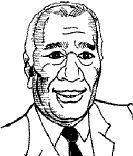
Hartley Neita NOEL CROSSWELL, who became Commissioner of Police in the 1960s, was first recruited as a Sub-Inspector of Police from the Colonial Secretary's Office in 1937 where he was a Second Class Clerk. Other senior police officers, above the rank of Sergeant-Major, were recruited like Crosswell from outside the Constabulary Force, many of them coming from England and Ireland.
An early manifestation of the different treatment given to members of the public arrested by the police was seen when Alexander Bustamante and St. William Grant were detained in 1938. A small item in the newspapers said that a cot was made available to Bustamante by the prison authorities while Grant slept on a bunk. Opinion at the time was that the preferential treatment given to Bustamante was because he was white even though it was explained he was too tall for the bunks. Grant, of course, was black.
It was in the 1950s that there were the first public expressions of concern about the employment policies of companies and other commercial institutions in Jamaica. The Mayor of Kingston, Councillor C.G. Walker, drew the attention of the commercial banks in Jamaica to its concern regarding the employment of qualified black persons as clerks, ledger keepers, cashiers, etc. in their institutions. The letter to them expressed the Council's great concern at the policy which existed in which "persons of Negro origin are only employed on the subordinate staff, while clerical and accounting posts are reserved for persons of fair complexion".
DISCONTINUED
The banks were told that the Council was of the view that this colour discrimination should be discontinued immediately in view of the fact that the great majority of the population consisted of black and coloured people, and they were asked to say what steps would be taken to change their policy.
Similar letters were sent to various companies, such as Texaco, Bryden and Evelyn and other private sector companies, and organisations such as the Jamaica Chamber of Commerce and the Jamaica Tourist Board.
Bank of Nova Scotia's response was that fully 80 per cent of its clerical, accounting and administrative staff consisted of native-born Jamaicans of all shades of colour". Texaco's reply to the Corporation's concern about the "frustration and despondency among qualified dark-skinned boys and girls", was that the resolution was endeavouring to have the company discriminate among prospective applicants on a basis of their colour.
Similar vague and sometimes slightly insulting replies were sent to the KSAC by the other banks and the companies contacted.
Walker then sought the assistance of the church, which was an approach the banks, for example, could not dismiss as the churches had large deposits in their accounts. One by one, the leaders of the church assured the Mayor of their full support to rid Jamaica of racial discrimination in all its forms.
'TWO-HEADED MONSTER'
In Montego Bay, too, Councillor Cecil Donaldson, who later became a Mayor, was also protesting against the practice of racial discrimination in that town. He described the practice by hotels as a 'two-headed monster' in that the head that was seen publicly said there was no racial prejudice, but the other frowned unseen at the thought of hosting black tourists.
Donaldson went further when he charged that no black persons were employed in the airlines offices. This was disputed by Councillor Walter Fletcher who said he could name at least five persons on the staff of these airlines who were black. To which Donaldson retorted he was not referring to the porters.
Came the 1960s, the Council of Afro-Jamaican Affairs petitioned Acting Prime Minister Donald Sangster about the need to change the way the national beauty contest was organised. The Council said that "in view of the fact that apart from a contest they held, and one by The Star newspaper, the national contest had, in the past, been weighted against the majority of the population".
The Council suggested that in order to correct this anomaly, it felt that for a period of three successive years, 1966, 1967 and 1968, the Government should run the Miss Jamaica beauty contest exclusively for black girls, and then in 1969 the fourth year it should be run exclusively for the minority groups, that is, everybody except for black girls.