By Tyrone Reid, Staff Reporter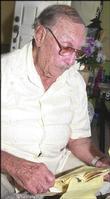
Ian Allen/Staff Photographer
THE YEAR 1959 will be eternally etched in Leslie Fitzmaurice Marsh's memory. But, not for good. It was the year he had a 'hell' of an experience. Today, more than a generation later, the 87-year-old is alive to tell the tale. Mr. Marsh, 35 years old at the time, was imprisoned in Baghdad, Iraq, under 'suspicion of espionage'. A crime that, he said, was punishable by death.
Sitting in his couch with head tilted backwards Mr. Marsh reminisced on the events of four decades earlier.
LINKED AS AN ACCOMPLICE
He told The Sunday Gleaner that he went to Iraq in 1952 as a service engineer at the Baghdad arm of the Joseph Lucas and Company Limited for which he worked while he was living in England. He developed a healthy rapport with the Iraqis. Seven years later, the good relationship they shared took a 180-degree turn after he was linked to a failed assassination attempt on the life of then Iraqi Prime Minister, General Abdul Karim Kassem on October 7.
His seven-year relationship with the Iraqis disintegrated into a seven-month-long saga as a prisoner and suspected enemy of the state. The authorities arrested Mr. Marsh on October 9 on the premise that he had connections with 'destructive elements' who plotted the attack. He was never officially charged. After the arrest came the reality of life in an Iraqi prison.
"They would have killed me. They wouldn't think twice about putting me outside and shooting me. They don't give you any time. When you go to court and they say you're going to die because you're a murderer, a thief or a rebellious man they just walk you out of the courthouse into the square and shoot you at the same time. The firing squad is there waiting on you. You don't have any time to worry about going to look for your mother or your father," he explained.
In recent times there have been reports of more than 20 foreigners missing in Iraq amid a spate of abductions by militants who are allegedly looking for bargaining chips in their fight against the U.S.-led coalition. However, many of the victims have been released and have told the tales of their horrid experience.
Mr. Marsh, a pre-Independence son of Jamaica, has seen both the best of times and the worst of times. He has been through four marriages and fathered more than 10 children. His detention in Iraq, he says, has left the worst mark on his life. "I went through hell because I never saw anybody. They didn't allow me to talk to anybody. I couldn't even speak to the guards," said Mr. Marsh as he recalled the agony of his prolonged 'nightmare'. The senior citizen has kept this ordeal in the closet of his heart for more than 40 years.
Only family members and close friends were privileged to hear what truly transpired during his incarceration in the Middle East. But, the Jamaica College graduate has finally decided to break his sabbatical of silence with The Sunday Gleaner who visited his haven-like home in Caribbean Park, St. Mary recently.
DEPLORABLE
Mr. Marsh said that the deplorable conditions of our nation's penal institutions would look like paradise standing next to what he was exposed to in Iraq.
"What I can tell you, that in our jails out here, we have nothing to compare with what goes on in their jails. Nothing... Those jails are the worst thing in the world. You get nothing that's to do with humanity," lamented Mr. Marsh.
He said overcrowding was a serious issue, as the rather small room was home to more than 30 detainees. "I had a corner and I could just sit down and lean down on the corner."
The jailhouse had a dirt floor, which the prisoners had to use as chair and bed interchangeably. Plus sanitary conveniences left a lot to be desired. "Sanitary facilities just don't exist in the jail. You have a hose there attached to a pipe in the same place where you (defecate) and you take it and wash your face and come out and that's all you get."
However, on the upside was the fact that water and food was provided. It was not of rice and peas and chicken calibre but it was welcomed. Since he was not privileged to a television or other forms of entertainment, he was reduced to watching the other prisoners picking fleas off themselves or each other.
When he thought things could not get any worse, his situation swiftly deteriorated. Mr. Marsh sustained an injury that he still receives electrical treatment for today and will have to nurse for the rest of his life. Mr. Marsh said he made a request to use the bathroom and was subsequently shoved into the impromptu toilet by the guard.
"They bore a hole in the ground and cement the top part and you do what you have into do in that hole. That is how I got damaged. One of the guards when I asked him to use the toilet, him just push me and seh see it right there... one foot went in and one was out and that is how I got injured. I hurt my back and it still trouble me up to this day," said Mr. Marsh as he recalled the harsh reality that was thrust on him.
Mr. Marsh said he was feeling a lot of pain in his back but his left leg was numb. The doctors in Iraq diagnosed his injury as spinal tumour and wanted to operate on it but when he arrived in England it was confirmed to be lumbar disc protrusion and he did an exploratory operation on his spine. Two weeks after sustaining the injury, Mr. Marsh was then taken to a military hospital in Baghdad, where he subsequently spent the greater part of his detention. During his stay in the hospital, Mr. Marsh said three judges and two army generals interrogated him for about three hours.
CONFINED TO A WHEELCHAIR
Finally, in January 1960, Mr. Marsh, who was confined to a wheelchair, made a two-hour appearance in the Baghdad People's Court as a prosecution witness. Dwinst Kadhem Al Azzawi, one of the 78 people accused of plotting to assassinate Iraqi Prime Minister, told the courts that Mr. Marsh was also a conspirator. Mr. Marsh denied all the allegations levied against him by Mr. Azzawi and maintains his innocence even today.
British Vice-Consul in Baghdad, G.W.R. Gilbert, visited Mr. Marsh while he was incarcerated and the British Government made perpetual appeals for his release. According to Mr. Marsh, Britain had to pull some fierce diplomatic strings in order to secure his release. "If it wasn't for the British, I might have been dead today," conceded Mr. Marsh with gratitude.
He was later released and arrived in England on Thursday May 5, 1960 with not even hand luggage. But, he did not care. "I had my suit, which was a jacket, pants, shirt and my underwear. I never had a suitcase or nothing. I was so glad I didn't ask them about my clothes," he said recalling his jubilee. "No sah. Nothing mattered whilst I got on that plane and it took off. That's all that I was looking for."
Mr. Marsh, who walks around with ease today, told The Sunday Gleaner that at his age he would not set foot back in Iraq and it is not because of his ordeal. "I wouldn't go there under these conditions now. If I was younger, maybe. But (only) if it settled down. I don't mind the country. It's nice. Lovely place."