By Norma Soas, Contributor 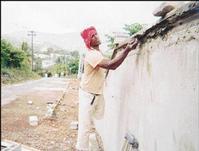
George Heron at work on a construction site. - Contributed
GEORGE HERON felt his life had come to a screeching halt when, in January 1991, the bus on which he worked as a conductor overturned after crashing into the Mother White bridge on Spanish Town Road in Kingston.
He did not lose consciousness after the accident. Lying inside the overturned bus amid the shattered glass and mangled metal, he noticed a female passenger who appeared badly hurt.
He started to crawl toward her to give whatever assistance he could. That was when he realised that his left leg was missing.
In the 14 days he spent lying on a bed in the Kingston Public Hospital, his frame of mind was one of total disbelief.
His thoughts turned to his daughter, born three weeks before the accident. He wondered how he was going to cope; what kind of work would he be able to do; would he end up on the streets at stop signs, pushing an upturned palm through car windows, begging a money as so many other men were doing?
STARTING PHASE TWO
George found it very easy to entertain thoughts of giving up on life. He was not a churchman, but not even the religious upbringing of his youth offered him solace.
But, he said, he had always worked hard never depending on anyone, and had no intention of doing so now, even with his injury.
He came to accept the fact that the leg would never grow back, but that his life was not over. "Once breath still a blow, me just couldn't give up," he said.
Thus started phase two of his life. When his baby's mother left him and the baby eight months later, his life at this point took on the tragic drama of the St. Louis blues.
George decided to spend some time with his mother who lived in Greater Portmore. This was at the height of a building boom there, and, with nothing to lose, he decided to visit some of the building sites in search of work.
To his consternation, the foremen took one look at him and thought his asking for work was some kind of joke. At this point the ridicule didn't matter, he had children to support, and so he continued his journey from one construction site to the next.
His dogged determination impressed one man, who hired him to lay blocks. After the first day he was told he was too slow, but the quality of his work was good and he was kept on.
He eventually could lay 300 blocks each day, and saw this as an opportunity to learn all he could about the masonry trade.
Now that he had a skill, and with so much building going on, George started to feel optimistic about his future.
His journey was not an easy one. Doing his job is, of course, more difficult and challenging than for the person with both legs. In addition, despite his skills he was still turned down for jobs on the grounds that he had a handicap.
Sometimes, George said, other workers complained, 'I don't know how the boss can take him work and give to one-foot man.'"
This kind of attitude from his own people, added to the burden of hopping through life on one leg.
Then he met a contractor who commented, after seeing him work, that he wished he had 10 one-foot men to work for him.
By this time George had increased his range of skills and was adept at carpentry and steel work and, according to the contractor, "You should see him dig a foundation."
This contractor started to use him on all his projects, even as far as Montego Bay.
Now George is a sub-contractor, hiring the workers on the sites. With a smile, George commented that sometimes healthy-looking men with both legs intact beg him for money.
Sometimes he gives them, but never without asking "How you so bright a beg one-foot man? A me should a beg you."