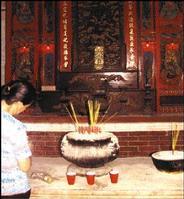
Family altar in Tien Sim Wei.
THE FIRST of our peoples were the Arawaks, or Tainos. Then came the Spaniards, the Africans and the English. Following the emancipation of slavery, Irish, German, a group called the Free Africans, Indian, and then the Chinese.
With the coming of the Chinese, and, later, the Syrians and other nationals from the Middle East, the Jamaican racial landscape became what was subsequently to be described as our national motto, 'Out of Many, One People'. These racial groups have integrated, more or less. They have even created a racial class called 'brownings'.
More than any other group, however, it is the Chinese who have spread their influence into the industrial, professional, commercial, cultural, and services sectors of the country.
Fifty years ago, a Chinese businessman, Lee Tom Yin, compiled a book that was mainly pictorial, of the Chinese in Jamaica. Now, fifty years later, and to mark the 150th anniversary of the arrival of the first Chinese families in Jamaica, another book, Jamaican Chinese Worldwide One Family has been published.
It is a work of love by, among others, Christiana Lee, who was responsible for the researching, writing, editing and proofreading.
Like the 100th anniversary book, this, too, is mainly pictorial, with photographs of the many families in Jamaica and of those who uprooted themselves 30 years ago to live in Canada and Florida, in the United States.
As the President of the Caribbean Chinese Association of Toronto, Canada, Michele Lyn makes the point that those who migrated planned to return to their birthplace, but as their ancestors did 150 years ago, they have stayed abroad, although maintaining strong family and other links with the Jamaican-Chinese at home.
The book tells the story of the Chinese migration to Jamaica from the Hakka Province of China. It corrects earlier recollections about those who were the first to arrive.
The first arrivals were in fact, on July 30, 1854, and they came directly from China where they were recruited by the British to alleviate the shortage of labour on the plantations in Jamaica, after the abolition of slavery.
When their contracts ended, some returned home or migrated elsewhere, but some 30 remained and started the small rural shops that changed the nature of grocery trading in the island.
For those readers interested in Chinese culture, the book provides a register of Jamaican Chinese surnames.
It also has maps and photographs of the Hakka villages in China, and an interesting story about the Chinese-Roman Catholic association in Jamaica.
For sports lovers, it tells of the role played by the Chinese in football and other sports in Jamaica, and of the Jamaican Chinese who joined the Royal Air Force during the last world war to fight Nazi Germany.
The dedication that it has been published to honour their ancestors, whose vision of a better life, took them to the other side of the world to a strange and new land, is a reflection of the respect the Chinese have for family.


















