Vernon Daley, Parliamentary Reporter 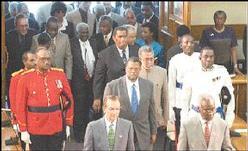
The opening of parliament. - File
THE PARLIAMENTARY Salaries Review Committee is expected to complete its report by the end of next month and the nation awaits its recommendations with boundless anticipation.
The committee has been engaged in extensive consultation with politicians, members of special interest groups, trade unions and ordinary citizens to get ideas for tackling this, admittedly, knotty issue of salaries for parliamentarians.
In the public debate on this controversial subject, there are two main camps: those who believe parliamentarians should be getting more money and those who think they are overpaid.
Politicians on the whole are not popular people and therefore citizens in any society usually react angrily when there is contemplation of giving them more money. The angry reaction of Jamaicans to news that MPs had been given more than a 100 per cent increase in their salaries, following the 2002 general elections, was predictable. The fact that the salary hike represented the accumulated increases that the MPs had foregone over several years was not sufficient to soothe tempers.
DIFFICULT JOB
Many of us who have been exposed to the difficult job that MPs perform in representing their constituencies as well as carrying legislative duties are sympathetic to the view that they should be paid more. However, while we may insist that our parliamentarians deserve better pay, there is the question of affordability: can the country pay them more at this point?
We have had little or no real growth in the economy over the last decade and many have seen a decline in their standard of living over that time. In such circumstances, it is going to be difficult for the Parliamentary Salaries Review Committee to make any recommendations that would see MPs getting more money, no matter how deserving they are.
Against that background, the debate needs to be shifted away from parliamentary salaries for the moment and focused on the conditions under which parliamentarians have to carry out their jobs. Many don't know it, but the facilities available for MPs to perform their jobs are quite inadequate.
For example, parliamentarians have no access to proper research facilities to help them prepare for debates in Parliament. They have no research assistants and, despite the best efforts, the library at Gordon House is inadequate. Is it any wonder that the quality of debates on important matters is often so poor? Unless the parliamentarian is a Minister or State Minister, there is no real provision made for him/her to properly prepare for the work of Parliament. That is unacceptable and whether we like politicians or not, we can hardly criticise them if we fail to give them the tools to do the job.
INTERNSHIP PROGRAMME
Some time ago, Senator Professor Trevor Munroe proposed the creation of an internship programme to use students at the University of the West Indies as research assistants for parliamentarians. What has happened to that idea?
The issue of constituency offices for MPs is also an area on which we have to put some focus. Currently MPs are not provided with constituency offices and the roughly $250,000 per annum they get for 'constituency expenses' is hardly sufficient to run a proper operation.
At a recent Gleaner Editors' Forum, James Robertson, MP for Western St. Thomas, pointed out that he had to use money out of his salary to maintain his constituency office and provide other services in his constituency. He is not unique. Others have found themselves in that situation.
The issue of state funding for political parties and elections is on the agenda. If we agree on nothing else we need to agree on the provision of well staffed and equipped state-financed constituency offices for MPs. The work of the MP is much too important to leave such a vital component to chance.
PUBLIC QUARREL
Also, we would prevent a repeat of the ugly public quarrel that erupted between supporters of Verna Parchment and supporters of Arnold Bertram, over the North West St. Ann constituency office following the 2002 general election.
In this very crucial debate, the focus should be less on the actual pay for MPs and more on the support services that we need to give them to make their jobs more manageable. It might be difficult to argue for increased salaries for parliamentarians in these hard times but I think we could find a way of selling the idea of funding facilities for parliamentarians that would allow them to perform their jobs better.
Send comments to: vernon.daley@gleanerjm.com