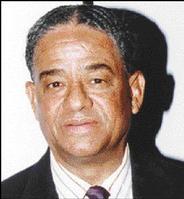
RATTRAYThe following are excerpts from the report submitted to prime Minister P.J. Patterson by Dr. Kenneth Rattray Q.C.
TERMS OF reference: Assessment of Culpability of Dr. Karl Blythe Former Minister of Water and Housing Arising from the (Angus) Report of the Commission of Enquiry into Operation PRIDE
The (Angus) Report acknowledges that the Commission did not have sufficient time to examine all relevant documents to facilitate the verification of some of the statements received during the interviews and consultation process and that they were made to understand that document existed.
Notwithstanding the time constraints recognised by the Commission, its modus operandi revealed two basic procedural defects which constituted fundamental flaws which would materially affect many of the Commission's essential findings.
DEFECTS OF THE ANGUS REPORT
The first procedural defect relates to the failure to observe the rules of natural justice by basing its conclusions on assertions without providing an opportunity to those affected to respond to such assertions. The Commission as an enquiry into the truth was under an obligation to disregard hearsay and not to base its findings on interviews for which no opportunity for challenge was provided.
The second procedural defect, perhaps explained by the insufficiency of time to examine all relevant documents but not excused by its failure to do so, was that in arriving at issues relating to accountability and responsibility of those involved in Operation PRIDE, and in particular of the Minister of Water and Housing Dr. Karl Blythe, the Commission arrived at conclusions without the benefit of the fullest and most rigorous examination of the facts including documents and to have permitted itself to be influenced by hearsay of unidentified persons.
Apart from the procedural defects identified above, there was a major substantive defect in that the Commission's Report is somewhat confusing by failing to adequately separate the periods during which the alleged deficiencies existed in arriving at findings and conclusions relating to Dr. Karl Blythe, former Minister of Water and Housing. As this analysis will indicate, a rigorous analysis would have shown that many of the allegations which attributed responsibility related to matters which took place prior to the assumption of responsibility as Minister of Water and Housing by Dr. Karl Blythe in February 2002.
Was there any Evidence or Finding of Corruption by Dr. Karl Blythe, former Minister of Water and Transport?
Corruption is essentially the abuse of public office for private gain for the benefit of the office holder or for a third party. There is no finding of corruption by the Commission in respect of the actions of the Minister. There is no evidence that the actions of the former Minister constituted an abuse of public office for private gain to himself or a third party.
"WHAT IS THE MINISTER DOING?"
It has to be recognised that no Minister would be expected to deal with the day to day running of Operation PRIDE but he is required to exercise sufficient direction and control to ensure implementation. It is against this background that many findings of ministerial influence must be judged.
IMPACT OF THE HOUSING ACT
But there is, an additional dimension to matters relating to Operation PRIDE and that is that most of the lands falling within Operation PRIDE are vested in the Minister responsible for Housing under the Housing Act. Under the Housing Act the Minister responsible for Housing is a Corporation Sole with the capacity to acquire, hold and dispose of land and other property. Specific powers are conferred on the Minister relating to the preparation and approval of housing schemes, so that there are certain statutory responsibilities falling on the Minister by virtue of the Housing Act which require his approval for particulars to be contained in schemes, including the estimated cost of the schemes and the receipts expected to be derived from sales.
The findings and conclusions of the Commission of Enquiry into Operation PRIDE do not address the constitutional issues nor the status of the Minister of Housing under the Housing Act. It is against that legal status that the issues raised by the Commission will now be analysed.
MINISTERIAL INFLUENCE
At page 38 of the Commission's Report under the heading "Ministerial Influence" the Commission states as follows:
"The Minister of Water and Housing has stated his position to the Commission to be carrying out his mandate from the Prime Minister to "get the programme moving." He indicated that proposed beneficiaries have been making deposits since 1995 and contracts have been executed for development. It is his position that the necessary paper work "should have been in place a long time ago." Consequently, he felt it as his obligation to finish these projects concurrently with the regularisation of the paper work, and so instructed NHDC. The Minister indicated that sale agreements were distributed and contracts for development were already in place when the programme was transferred for implementation under the Water and Housing portfolio. He noted efforts that were made to revise the substantially undervalued prices in the sale agreements, amend contracts to introduce a phased implementation process with termination of NHDC's intimate involvement at the end of level I development. He stated, however, that many IPs resisted and several contractors refused to agree to the proposed amendment. As a result, the Minister felt that there was no other choice but to proceed with development based on what was already in place. The Commis-sion feels this is highly irresponsible particularly in light of the document submitted to the Minister in February 2000 which details problems NHDC encountered as a result of this very same practice, its negative effects on the organisation, project developments, and the PRIDE programme. Further, proper contracts were not executed and loan agreements were not in place. There was therefore no obligation of GOJ to provide financing as agreements, where existing between the IPs and their Consultants/Contractors, created no legal rights to receive any funding from NHDC." Essentially, in finding that the action of the Minister was highly irresponsible, the Commission sought to rely on the absence of revised loan agreements and contracts to reflect the revised cost before providing bridge financing to the Industrial and Provident Societies, in view of the acknowledgment by the Minister of Water and Housing that efforts to revise agreements were resisted by the Industrial and Provident Societies and that several contractors had refused to agree to proposed amendments. In coming to its conclusion it appears that the Commission did not pay sufficient attention to the available documentation which indicated that the Minister had negotiated amended lot prices with the Industrial and Provident Societies with consequent upward adjustment in prices on the sales agreements.
MINISTERIAL INFLUENCE EXCEEDED MATTERS OF POLICY
The second conclusion in relation to Ministerial influence relates to the finding that the Minister did not confine himself to matters of policy but was involved in the detailed administration of Operation PRIDE.
It is in this context that the Commission recommended that:
"Ministerial influence is restricted to guidance with respect to general policy issues and not to extend to the daily administrative operations of NHDC."
Whilst the Minister cannot be expected to deal with the day to day running of the NHDC, in dealing with Operation PRIDE he is legally required to go beyond policy because under the Housing Act specific powers are entrusted to the Minister of Housing and the lands are vested in the Minister as a Corporation Sole. He must therefore give his approval for Contracts, including Loan Agreements.
The Housing Minister in the exercise of his powers under the Housing Act cannot abdicate his responsibility in relation to matters relating to lands in his name owned by the people. In the discharge of that responsibility he cannot confine himself to "guidance with respect to general policy issues." The Minister as a Corporation Sole under the Housing Act is accountable and responsible and must therefore exercise such supervision and exercise his legal powers as are conferred on him by the Act in his capacity as a Corporation Sole.
The findings and conclusions of the Commission in relation to the role of the Minister in relation to Operation PRIDE are based upon a fundamental misunderstanding as to the status of the Minister of Housing under the Housing Act and his responsibilities in relation to lands vested in him for the purpose of Operation PRIDE.
SUBMITTING BENEFICIARIES' NAME FOR MINISTERIAL RATIFICATION AND BY PASSING CABINET POLICY
The Commission's Report has noted documents indicating that the Minister of Water and Housing instructed that in the event of beneficiary "dropouts" from developments, the list of suggested replacements (as indicated by the relevant Industrial and Provident Society) should be submitted to him for ratification, thereby bypassing approved Cabinet policy.
The Commission has failed to place in context the circumstances in which instructions were given in relation to beneficiary dropouts. Those circumstances related expressly to Melrose Mews in which persons had dropped out because of the increased price and a decision had been taken to reduce those increased prices.
The Commission asserts that the Technical Services function of the NHDC in respect of site assessment and selection, design, project implementation and funding was de facto reduced by being steadily removed from the NHDC and incorporated in the Ministry of Water and Housing under the direct supervision of the Ministry through the CECL, the Technical Adviser to the Minister and the collaborative unit in the Ministry.
It should be noted that when the Ministry addressed the Board of NHDC in September 2000 (Appendix IV of Commission's Report and which is reproduced as Appendix III hereto) he indicated that the pool of technical resources within Government Agencies under the Ministry should be fully utilised and that the Board of NHDC should instruct Management to utilise the technical persons who exist across the Ministry, including NWC Engineers and CECL. Part of the rationale for this was that for PRIDE Projects the Corporation should always seek to find cheaper resources internally. The collaborative unit provided technical and managerial support from the Ministry and clearly assisted in the implementation of the programme.
The suggestion by the Commission that there was a parallel organisation within the Ministry of Water and Housing demonstrates a failure to appreciate the inadequacy of the technical resources within the NHDC and the wisdom of having full collaboration between the agencies falling within the Ministry.
The Commission has made adverse comments on the Ministerial instruction to NHDC to pay invoices to CECL on relocation 2000 notwithstanding NHDC's advice that relocation 2000 is not within Operation PRIDE and any such payment may be subject to an audit query. The evidence suggest that the matter was discussed between NHDC and Minister of Water and Housing and all seem to have understood that the invoices related to expenses which rightfully should be paid by NHDC because it was an Operation PRIDE expenses. In fact, the expense related to relocation of low income groups which is Group 3 within the 11 PRIDE Career Groups stated in Cabinet Submission MEH 48/97. In fact the same Cabinet Submission in giving examples of relocation of low income groups listed Seville Phase which is the site from which the persons were to relocated to the new site which relates to the expenses incurred.
The Minister's instructions did not seek to direct the NHDC in any unlawful act. It expressly stated: "I am asking you to find a way to meet them in such a manner which will not bring an audit query." But the Commission's Report speaks in terms of: "to structure the payment in such a way as to avoid such a query".
The Minister in his instructions was clearly recognising that the payment had to be made in a legitimate manner and, according, his authorisation for the expenses was on the basis that it should be done in a proper manner, that it, to be done in a manner which would not bring about an audit query; the innuendo that the Minister's instruction was to do something improper is clearly unjustified.
MORANT FARMS AND ALBION DEVELOPMENTS
The Commission has asserted that it has been unable to ascertain from any persons interviewed the authority by which Morant Farms and Albion West Developments were selected and treated as priority projects. There is no indication as to the persons interviewed by the Commission. The Minutes of the NHDC Project Committee meeting held on the 20th November, 2001 disclose the circumstances in which the NHDC identified the Morant Farms and West Albion Projects. Extracts from those Minutes are attached as Appendix IV hereto. At that meeting Mr. Honeywell the Managing Director of NHDC advised that discussions had shown that there was not enough PRIDE Projects in St. Thomas and that there were three major projects that the NHDC was looking at - Morant Farms, Donaldson and West Albion and that work had commenced on all these three projects. It is clear that the NHDC had concerns about the lack of projects in St. Thomas and thus the reason for treating these projects as priority. Safeguards instituted by the Minister of Water and Housing.
The Commission is critical of the inadequacy of the systems in providing safeguards for protecting Government's interests in respect of Operation PRIDE. The Commission has failed to note the measures instituted by the former Minister of Water and Housing in order to provide adequate safeguards, and did not seek clarification or explanation from the Minister in relation to their concerns. It is therefore necessary to record the measures which were instituted by the Ministry of Water and Housing to safeguard the Government's interests. These include the following:
- The In-house planning Unit (Collab/Housing Con-struction Unit) reviewed sites, reviewed and certified designs, and monitored construction.
- The insistence of an accountable officer being signatory to all provident society accounts with a block on payments to provident society projects refusing to implement this, and ultimately the establishment of a single NHDC account to which all funds are lodged.
- The adjustment of sale agreements to reflect a new selling price, more in line with development cost.
- Insisting that loans granted by Government covered work to level one only.
- Implementation of fixed price contracts where possible.
- Obtaining approvals from the relevant regulatory agencies.
- Ensuring loan agreements are in place.
- Ensuring mortgages are in place.
- Ensuring that 20% deposits from provident societies are in place.
- Implementing a new policy to govern the award of contracts (June 1, 2001).