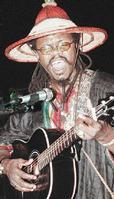
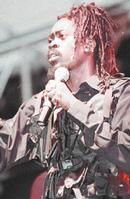
Luciano (left) and Beenie Man.Leighton Williams, Staff Reporter
WHEN IT comes to United States' (U.S.) Billboard charts, roots reggae singers must be humming Bob Marley's Waiting In Vain. On the other hand, however, the dancehall fraternity must be singing 'dem a go tired fi see mi face'.
Dancehall music's relative success in the United States has been attributed to one factor by industry players. Marketing.
"It's because of marketing why dancehall has been popular in the United States. The companies don't promote the (roots) reggae acts enough," opines producer Mikey John. Mikey John's works include Warrior King's Virtuous Woman and Luciano's Come Away.
Veteran manager Copeland Forbes agrees.
"A part of the reason for the success of some of these singles is because they have the push of big labels behind them. Dancehall is also marketed more than reggae in that area. Other forms (of music) won't even get that attention. A record company person told me he was not interested in culture and religion. He was interested in selling records. Dancehall has done well because it has received more marketing," said Forbes.
Copeland Forbes, with over 40 years experience in the music business, managed the late Peter Tosh and is currently managing Luciano.
A look at Billboard for the 1990s shows that several dance-hall songs did well on the singles chart.
Album-wise the genre has also had some success from Shabba Ranks, Mad Cobra, Buju Banton, Shaggy and, to a lesser extent, Beenie Man and Sean Paul.
From 1991 to the present, at least one dancehall song has presented itself on the Billboard singles chart every year. The early 1990s was an especially good period for dancehall, with acts such as Shabba Ranks, Chaka Demus and Pliers, Mad Cobra and others recording successes in the United States market.
In 1991, Shabba Ranks and Maxi Priest's Housecall peaked at number 37 on the Billboard Hot 100 Chart and number four on The R&B/Hip-Hop Singles chart. Shabba would duplicate this success in 1992 with Mr. Loverman, which went to number 40 on the Billboard Hot 100 and number two on the R&B/Hip-Hop Singles chart. In addition, his other singles The Jam and Slow and Sexy charted as well.
In the same year, Cobra slithered onto the R&B Hip-Hop Singles chart with Flex and peaked at number 13 the following year (1993) on the Billboard Hot 100 charts with the song.
Ini Kamoze was better known for roots reggae lyrics on heavy dub beats in the 1980s before in 1994, he departed from that path and walked all the way to number one with the dancehall/hip-hop influenced Hot-Stepper.
The following year would see Shaggy's Boombastic climbing to number three on the Billboard Hot 100 singles chart and to number one on the R&B/Hip-Hop Singles chart.
Patra's Scent of Attraction sniffed its way to number 82 on the Billboard Hot 100 chart and to number 31 on the Billboard Hot R&B/Hip-Hop Singles chart in 1996.
Beenie Man and Chevelle Franklin's Dancehall Queen peaked at number 90 on the Hot 100 and at 84 on the R&B/Hip-Hop chart in 1997.
Beenie Man would repeat that success in 1998 with Who Am I, which topped out at number 40 on the Hot 100. His Shocking Vibes stablemates Tanto Metro and Devonte would also find their song Everyone Falls In Love on Billboard the following year.
'The Doctor' would then find his way to number 54 on the Hot 100 with Girls Dem Sugar in 2000.
Shaggy proved to be a hot shot in 2001 when his singles It Wasn't Me and Angel both hit the top spot on the Billboard Hot 100 chart.
Of course, dancehall's latest international success, Sean Paul, would also shine the genre's torch on Billboard in 2002 with Gimme The Light, which peaked at number seven on the Hot 100 charts.
In comparison, roots reggae successes have come via Ziggy Marley and the Melody Makers, who hit the Hot 100 with Good Time in 1991. Jimmy Cliff saw some success in 1993 with I Can See Clearly Now. Non Jamaican groups UB40 and Big Mountain also charted in the 1990s. UB40's Can't Help Falling in Love With You helped itself to a number one spot on Billboard Hot 100 in 1993 and Big Mountain was successful with a reggae version Baby I Love Your Way in 1994.
Producer Rohan 'Snow Cone' Fuller, who worked with United States producer Salaam Remi on Ini Kamoze's Hot-Stepper, also believes that marketing has played a role in the success of dancehall. However, he puts another different spin on the matter.
"America deals with marketing, fast money and fast catchy rhythms. So you will find dancehall doing well in the United States. Also, roots reggae has never been popular on the East Coast of the United States and it won't be popular because the rhythm is not fast. The successes are mostly on the West Coast. But apart from that, the roots reggae producers 'lick over' (redo) too much rhythm, so you won't find it being too popular," said Snow Cone.
However, the idea that roots reggae has been left 'talking the blues' when it comes to marketing is not far-fetched. Most dancehall songs that have taken off in the US received one important marketing tool. A music video. In at least one case, the presence of a video helped in promoting a dancehall song.
Sean Paul's Gimme The Light took off as a result of a video and industry players point out that a part of Shabba's success was as a result of him having strong videos in the early 1990s. In contrast, there has been very few roots reggae music videos getting major airtime in the U.S.
Yet another verse to the song is that both VP and Greensleeves, reggae's primary distributors in the U.S., market mainly rhythm driven compilations, various artistes compilations, several dancehall acts and few roots reggae acts.
Yet the view that roots reggae is not marketed aggressively is disagreed with by Treasure Aarons, promotional director in the U.S. for Greensleeves Records.
There's (probably) an overflux of dancehall artistes. There are a lot of dancehall artistes in comparison to roots reggae singers. Most upcoming artistes go to dancehall and not many go to roots reggae. For every roots reggae artiste that comes up there are a lot of dancehall (artistes), so it will always appear that dancehall is getting more attention," Aarons says.
"Roots reggae is popular on the West Coast. You may find an upcoming dancehall act struggling on the East Coast as opposed to the West Coast. You just have to find your target market," said Miss Aarons.
Snow Cone adds however that roots reggae has still remained popular underground despite dancehall crossing over into the mainstream.
"When roots reggae comes with originality it works. A lot of songs do well, but they are not highlighted because it is not fast. But roots reggae still get the Grammy," said Snow Cone.
When it comes to the Grammys it is roots reggae that has flung We Run Tings back in the dancehall fraternity's teeth.
A look at how the Grammy Awards have gone over the years show a heavy leaning towards roots reggae. Out of 17 Grammy Awards for 'Best Reggae Album', roots reggae has walked away smiling at least 11 times. Dancehall has only copped four.
On the other two occasions - 1998 with Sly and Robbie and 2001 with Damian Junior Gong' Marley there has been some dispute due to the rhythms, which made it difficult to categorise them as either roots reggae or dancehall albums.
Dancehall's triumphs have come via Shabba Ranks (1991 and 1992), Shaggy (1995) and Beenie Man (2000).
Dancehall s momentum, however, seems to be building as the upcoming awards for 2002 have seen the most dancehall nominations, with two of the five albums being hardcore dancehall efforts. The two hardcore projects are Still Blazin from Capleton and Ghetto Dictionary: The Mystery by Bounty Killer.
"Grammy is not based on record sales. It's based on the best reggae recording. If a man does a dancehall tune and it sells millions it may not even make the Grammy list of nominees. The message music (roots reggae) usually wins over the dancehall," states Copeland Forbes.
He adds, "Dancehall sounds like hip-hop, so a lot of Americans will gravitate towards it faster. But in Europe it is roots reggae that is the preferred genre. You have many reggae groups in Europe that you have never heard about in Jamaica."
Forbes view that dancehall and hip-hop have similar sounds is not inaccurate. Sean Paul and Busta Rhymes recently teamed up to do the remix of Make It Clap, with Sean Paul riding what is viewed as a hip-hop rhythm fairly easily.
This is only natural, though, seeing hat hip-hop came out of dancehall and there have been Jamaican deejays like Supercat who have 'toasted' to great success on hip-hop rhythms, for example the Jump remix with Kriss-Kross.
However, while roots reggae is yet to consistently gain mainstream attention in the United States. Snow Cone points out that the style should be respected since it is the foundation of Jamaica's musical landscape.
"You can't dis roots reggae because it is the foundation for dancehall. No matter what, it is responsible for Jamaica gaining recognition through music," he stated.