By Eulalee Thompson 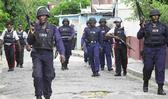
- Michael Sloley /Freelance Photographer
The study revealed restriction of the policemen's social life
and impaired family relationships due to the level of exposure to
traumatic stress and violent crimes in their daily duties
- Dr. Myo Kyaw Oo, psychiatrist, Junior Doctors' Association Symposium.
IF SOME of the members of Jamaica's police force were returning from the Vietnam War, they would be described as suffering "shell-shock" or "battle fatigue". They haven't been fighting in the Vietnam War, but psychiatrist, Dr. Myo Kyaw Oo, who has been studying mental health of local police officers, says
that they are suffering the same syndrome
only now it is known as posttraumatic stress disorder (PTSD).
Dr. Oo, lead author of the first local study on "Posttraumatic Stress Disorder among Jamaica Constabulary Force Personnel" reported his findings at the recent Junior Doctors' Association (JDA) symposium. He reports that a significant number of policemen and women who participated in the study, were found to meet the diagnostic criteria for partial posttraumatic stress disorder (PTSD).
His study of 134 police officers, from eight randomised stations in Kingston and St. Andrew, in addition to a focus group discussion of 27 officers from three special unit, found that partial PTSD was more prevalent among certain subgroups in the study, such as:
- policemen working in the volatile areas of Kingston and St. Andrew
- those with 14 years of service and fewer
- among the younger policemen -- those in the 20 to 39 age group;
- those who reported that they received poor community support
- those who reported psychosocial and environmental stressor and
- those with low GAF scores.
Dr. Oo explained that PTSD is diagnosed based on fixed criteria set out in the Diagnostic and Statistical Manual (DSM IV). The criteria include exposure and response to trauma; re-experiencing symptoms; avoidance; hyperarousal symptoms; all these symptoms affect the individual's daily functioning. Those meeting the criteria for partial PTSD display only some of the symptom of PTSD.
"The qualitative study suggested why PTSD was not identified in the quantitative study: officers were reluctant to admit their symptoms because of feelings of stigmatisation, insecurity, mistrust or fear of victimisation or because of concerns over confidentiality," Dr. Oo said.
He said also that the study revealed restriction of the policemen's social life and impaired family relationships, due to the level of exposure of traumatic stress and violent crimes in their daily duties. The policemen in the study were also concerned about working conditions, welfare services, community support and were dissatisfied over transportation, incentives and promotion.
Though, Dr. Oo says that the study points to the need for far more recognition of the effects of PTSD, he warned against drawing firm conclusions due to the small sample size and other limitations in the study.
STUDY POPULATION
- 134 policemen -- 120 males of a mean age of 39 years and 14 females of
a mean age of 37 years
- Range of years of service was one to 35 years with an overall mean of 14
years
- 37 per cent of them were married and 29 per cent were in common-law union
- 67 per cent had completed secondary school education
- 62 per cent were assigned to stations considered to be in moderate to highly
volatile area
- 32 per cent had received injuries in motor vehicle accidents, 12 per cent
reported injuries by gunshot.
- 67 per cent completed secondary school education.
Posttraumatic Stress Disorder
Exposure to or witnessing trauma can produce intense fear, horror or helplessness and form the basis for the development of Posttraumatic Stress Disorder (PTSD). Dr. Myo Kyaw Oo, psychiatrist, indicates that the Diagnostic and Statistical Manual of Mental Disorder (IV) describes very clear cut criteria for the diagnosis of the condition.
Some of the diagnostic criteria and feature include:
- re-experiencing the trauma either through flashbacks; recurring dreams
of the trauma or incident; acting or feeling as if the event is recurring;
reacting with the same response when expose to the same cue (for example,
places or people who look like the trauma event)
- Avoidance symptoms include avoiding thoughts, feelings, conversations that
remind victim of the trauma; avoiding places or activities, people that remind
victim of trauma; memory blockage or inability to recall the trauma; feelings
of detachment and estrangement from others; restricted range of affect/range
of emotion is limited
- Hyperarousal symptoms -- difficulty falling or staying asleep; irritability
or outbursts of anger; hypervigilance; exaggerated startle response
- The disturbance causes clinically significant distress or impairment in
social, occupational or other important areas of functioning.


















