| Home Page Lead Stories News Business Sport Commentary Letters Entertainment Arts &Leisure Outlook E-Financial Gleaner Subscribe Classifieds Guest Book Submit Letter The Gleaner Co. Advertising Search |














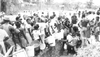
The 1990s: Consumerism and debt September 15, 1988. Wherever water could be found the people rushed to get some. Here a group on St John's Road, Spanish Town, awaited their turn to catch water from this broken main.
THIS IS the final in a five-part series on Jamaica after the Second World War. ON SEPTEMBER 12, 1988, Hurricane Glibert blew ashore, destroying property and dislocating the economy. Jamaica incurred losses amounting to $956 million. The country suffered damage to its agricultural, tourism, industry, housing and economic infrastructure. Subsequent to that period, inflation rose by 30 per cent, expenditure to effect repairs increased by $220 million, and the public sector deficit rose from 2.8 per cent to 10.6 per cent of the GDP. The JLP lost the elections of the following year, though it was widely felt that the relief efforts following the disaster had been exceptional and swiftly executed. The period after Hurricane Gilbert, and the return of the PNP, leading into the early 1990s, will be remembered as the era of the sliding dollar and runaway inflation, and the monstrous mounting of public and private debt as consumerism. Financial crash It set the stage, in the second half of the decade, for the financial crash that came. Runaway dreams (business and individual) were extinguished as financial institutions died, or were crippled beyond recovery. Professor Norman Girvan, in a published analysis on the expansion in credit that blew in with the 1990s and liberalisation, comments: "There was clearly an excessive expansion of credit and the money supply. Except for a brief period of restrictive monetary policy in late 1989 and early 1990, the Government followed a policy of deregulating credit controls and lowering interest rates, in response to pressures from the private sector. The result was that over the period as a whole (February 1989 to September 1991), the money supply grew by $2,156 million or 78 per cent, and credit to the private sector grew by $5,153 million or 103 per cent. "A lot of the new credit went towards financing consumption; in the year preceding full liberalisation (September 1990-September 1991) consumer credit from the banks grew by 91.95 per cent, or over three times the rate of growth of total private sector credit. Good business for the banks and the import traders; bad business for Jamaica as a whole." Carl Stone, political scientist, in his analysis of what the 1990s had brought in, said: "Working class purchasing power was in fact increasing under the JLP between 1986 and 1989. Under the PNP in the 1990s even with the removal of the wage guidelines in 1991 by the PNP and the increase in the rate of wage increases, the working class is much worse off because of the extraordinarily high and unprecedented inflation rate." They might have been worse off. But who was responsible for the growth in consumption? Cheap consumer imports and second-hand/re-conditioned cars flew off the shelves and ramps as soon as they landed. "And, once the exchange rate started to slide, speculators moved in to kill the dollar by buying up large quantities of US dollars in anticipation of a continually declining exchange rate for the Jamaican dollar. Investments in foreign exchange became the most lucrative investment. The loose control over money supply encouraged these trends to escalate to levels that killed the dollar and savaged our cost of living," the columnist said. In the 1980s workers consistently breached the guidelines achieving wage increases that were usually more than 50 per cent higher than the wage guidelines. Cost-of- living increases went through the ceiling, even with wage increases running at twice the level of the 1980s. Currency liberalisation The timing of currency liberalisation did not help. As the exchange rate continued to slide after currency liberalisation, it took the Gordon "Butch" Stewart and Save-the-Dollar initiatives to stabilise the exchange rate by putting the dollar speculators to flight. The initiative was to offer only temporary respite. Inflationary increases in house rentals, water rates, electricity rates and continued increases in food prices accompanied the floating devaluation of the dollar. Hard currency payment arrears and capital flight represent the greatest near-term threat to social and economic stability. Mr. Manley demitted office, on March 29, 1992, replaced by P.J Patterson, who, in the general election of 1993 won the position in his own right. Polls showed that some of the electorate thought he had "sold out". There was one sector that profited nicely from the crazy effects of fiscal policy, however. It was the banking sector which now set its own interest rates and raked in millions. Soon enough, however, under a burden of debt, growth slowed in the economy, companies began to suffer from the interest rates and went under. Downsizing and redundancies did not help. The banks themselves began to feel the pressure. The crash among financial institutions which started in 1995, was fuelled by several factors. Omar Davies, Minister of Finance and Planning, was to outline the reasons after the debacle had run its course. They were: FINSAC, the Financial Sector Adjustment Company, was born to mop up the disaster that no hurricane could equal. Until today, many institutions hang precariously, only tottering upright with this organisation's help That the PNP won the final election of the century after the crash, was not unexpected, however. The JLP spent much of the decade of the 1990s stitching itself together, after repeated ripping apart by infighting and leadership challenges. The election was soon forgotten however, under a new fright -- that of the coming of the year 2000, of computer glitches and the possible disaster this would bring. Source: Articles from The Gleaner newspaper.
|