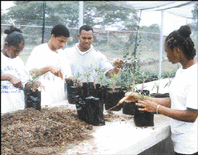













School Garden Programme rekindling interest among students THERE IS a cadre of young farmers in western Jamaica who are keen on pushing agriculture forward, through the School Garden Programme. They are found in the Primary, All-Age, Technical and High schools in the region. The programme has been introduced in some 28 schools in the parishes of St. James, Hanover and Westmoreland, and with assistance from the Rural Agricultural Development Authority (RADA), the schools are earning thousands of dollars from the sale of crops. Deputy parish manager for RADA in St. James, Donald Robinson, says that the programme is serving as an encouragement to the students to take up farming as a career, and to show them that agriculture can be profitable. "We are hoping that this will assist them to gravitate towards agriculture," he added. He points out that currently there are eight schools in St. James involved in the School Garden Programme, and that production at these schools over the past year has been very encouraging. Other schools are now showing much interest in the project. "There are plans afoot to increase the number of schools in the programme. As a matter of fact, eight project profiles were done for eight additional schools," Mr. Robinson notes. The schools already in the programme in St. James are Bogue Hill Primary, Sunderland and Lottery All-Age, Garlands Junior High, Catadupa Primary and Junior High and Anchovy, Maldon and Cambridge High Schools. These schools produce crops such as pineapple, banana, plantain and various types of vegetables. They are also involved in the production of broiler chicken, and in apiculture. Exposure On average, about 100 students in each school are exposed to farming annually. Teachers responsible for teaching Agricultural Science are also reporting higher levels of interest and more passes in examinations in that subject area. They attribute this success to the hands-on experience the students are receiving. Over in Hanover, the RADA Parish Manager, Stanley Dodd, says sales from the seven schools in the programme grossed over $2 million last year. The participating schools are Success Primary and Junior High, Askenish, Chester Castle and Cave Valley All-Age, Green Island and Merlene Ottey Comprehensive High and Knockalva Technical High. He notes that Success Primary and Junior High grossed $113,600; Askenish All-Age $101,700; Chester Castle All-Age $366,100; Cave Valley All-Age $138,900; Green Island Comprehensive $1.4 million; Merlene Ottey Comprehensive $23,200 and Knockalva Technical High $91,300. "Chester Castle All-Age is the standard bearer in the programme in this parish, as the students have dramatically expanded their project to include cattle, pigs and rabbits, and have utilised a portion of their profits to partially fence the school compound," Mr. Dodd points out. "All in all, I would want to say that the School Garden Programme is very successful," he says. Mr. Dodd explains that the response from the students towards the programme has been very good so far, adding that he sees the programme having some positive effects. In Westmoreland, 13 schools are participating in the programme, and RADA Parish Manager, Conrad Tharkur, says the programme is the best way of introducing farming to the youngsters. He points out that the participating schools in the parish are mainly involved in short-term crop production, with two of them doing well in broiler meat production. Manning's High School and Peggy Barry All-Age are the two institutions engaged in meat production, and both produced over 6,700 kilograms of meat over the last year.
Training
"I think this programme is contributing significantly to the training, and the nutritional needs of the students, as well as providing well needed additional income for the schools," Mr. Tharkur says. Head of the Manning's High School's agricultural science department, Peter Lacan, said that the programme has generated a profit of over $2 million to date, some of which has been pumped back into the programme. He points out that since the exposure to farming, the students have been achieving a 90 per cent pass rate in Agricultural Science in CXC examinations. Mr. Lacan notes that students from grades 7 to 11 participate in the programme, but the primary focus is on grades 10 and 11 students who are preparing for external exams.
|