| Home Page Lead Stories News Business Sport Commentary Letters Entertainment Arts &Leisure Outlook E-Financial Gleaner Subscribe Classifieds Guest Book Submit Letter The Gleaner Co. Advertising Search |













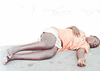
Rescuing unhappy children Neglected children, like Kemar, who sleep in New Kingston, may end up with both physical and mental difficulties.
Avia Ustanny, Feelance Reporter
COULD your child be suffering from a mental disorder? The stigma attached to those with mental challenges both encourages us to ignore these issues in children and, the experts are telling us, also feeds the lake of ignorance around the problem. We readily label children as 'difficult' or say they have a 'personality problem'. No one wants go for help. No one wants to use the 'M" word. And they should not, says Dr. Liba Thomas, paediatrician attached to the Child's Guidance Clinic of the Bustamante Children's Hospital. "We shy away from the use of such terms because of the stigma attached. Also, they really do not present the same picture as adults who suffer from mental problems," she said. What lies behind the debate over terminology is a serious and often ignored issue. Mental health statistics from the child guidance clinics in Kingston, St. Andrew and the St. Catherine area indicate the following rates: In the United States, it is estimated that 10 to 15 per cent of all children and adolescent at some point in their lives have a mental health problem. The figure may not be too different from here. Locally, the age range most frequently exhibiting conduct disorder and oppositional defiance fall in the 10 to 14 age group. Those with attention deficit disorders are usually in the 5-9 age group. Surveys also indicate that 64 per cent of all children suffering in all categories were affected by child abuse. In the categories listed, disruptive disorders include attention deficit with hyperactivity. They may also include conduct disorder and oppositional defiant disorder, as well as antisocial behaviour disorder. Attention deficit (ADDH) is characterised by patterns of inattention - for the development age, and/or hyperactivity and impulsivity. Conduct disorders are noted where the basic rights of other children are violated and major age appropriate societal norms and rules are violated (children do not act their age). In children, the main forms of misconduct include: The child in trouble is one who shows oppositional defiant disorder towards authority figures which persists for six months or more, who loses his temper a lot, and who deliberately does things to annoy other people, and is angry and resentful. Child or adolescent antisocial behaviour includes isolated antisocial acts which do not qualify for conduct disorder. This may involve just one act. Children with relationship problems may show these when under stress, such as a change of caregiver, change of residence and loss of a parent either to death or migration. The numbers of children reported for care and counselling at the Child Guidance clinics are on the increase. There are more referrals, Dr. Thomas states, but notes that the time-intensive service and small number of staff limits the ability to deal with these. The complexity of the cases is also increasing, with more serious cases. The cases are often associated with lower socio-economic levels, harsh punitive parenting and family discord, lack of appropriate parental supervision, chaotic homes, substance abuse in parents, as well as child abuse or child neglect.
|