| Home Page Lead Stories News Business Sport Commentary Letters Entertainment Arts &Leisure Outlook E-Financial Gleaner Subscribe Classifieds Guest Book Submit Letter The Gleaner Co. Advertising Search |














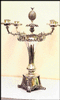
Historical candelabrum back home This beautiful four-branch silver candelabrum, which was being auctioned on the Internet in California, was donated to the East Queen Street Baptist Church.
Georgia Hemmings, Staff Reporter
IT'S A tale which began in Jamaica, wove its way across the miles to California in the United States, before ending here again. It's the story of a Victorian four-branched silver candelabrum which has become part of the island's collection of historical artefacts, and which was donated recently to the East Queen Street Baptist Church. The tale began in 1846 with the presentation of the beautiful candelabrum to the Reverend Samuel Oughton, then pastor of the East Queen Street Baptist Church. He was held in high esteem by his congregation as a "man of more than ordinary power in the pulpit and on the platform", and it was during his period of service that the church was enlarged. Reverend Oughton and his wife, Hannah, had a close involvement with the congregation and took keen interest in social change, especially in the post-Emancipation period. The candelabrum presented by the congregation was crafted by Roberts & Slater of Sheffield, England. It has an architectural base with four outset corners, and a tall lobed baluster stem rising to a collar, and supporting four detachable scroll arms with candle and shade fittings. The centre has a sconce support and an ornamental pineapple at the top. At the time it was created, the candelabrum was 28.5 inches high and weighed 19 pounds. It was presented to the pastor with the following inscription engraved on two of the base panels: "This memorial of Christian affection is presented by the Deacons, Leaders and members of the Baptist Church East Queen Street to the Rev'd Samuel Oughton in commemoration of the seventh anniversary of his pastoral superintendence over them and as a tribute of that high esteem with which they regard his public and private character united with their admiration of the talent, zeal and fidelity which have so eminently distinguished his ministerial career (Jamaica, February 4, 1846)". Mystery What happened to the candelabrum during the ensuing years is still a mystery to researchers at the Institute of Jamaica (IOJ), which played a prominent role in its recent acquisition. IOJ Public Relations and Development Officer, Clover Johnston, told The Sunday Gleaner that it was Dr. David Boxer, chief curator at the National Gallery of Jamaica, who first saw the candelabrum being auctioned on the Internet from an auction house in California. "Dr. Boxer saw the candelabrum, and recognised it as a historical piece from Jamaica because of the pineapple finial," Mrs. Johnston explained. "And it was Dr. Boxer who initiated the effort for its acquisition." While declining to state the amount spent in procuring the candelabrum, Mrs. Johnston admitted that the item was "rare and very valuable." Having acquired the piece, the Institute felt it was fitting that the candelabrum be given back to the East Queen Baptist Church from which it had originated. 'Moving moment' On May 20, the beautiful historical artefact was presented to pastor, Reverend Dr. Roy Henry, by Professor Barry Chevannes, chairman of the IOJ. "It was a truly moving moment to hold that beautiful candelabrum," Rev. Henry told The Sunday Gleaner. "And to be reminded of our continuing mission of service as exemplified by the life of the late Rev. Samuel Oughton. "We are deeply appreciative of the kind gesture by the Institute in presenting this artefact back to us, especially as it comes so fittingly during the continuing celebrations of the 200th anniversary of the East Queen Street Baptist Church." For the IOJ - mandated to collect, preserve and present information on Jamaican heritage - the task of acquiring the candelabrum was worthwhile and satisfying. "We are proud to add this candelabrum to the national collection of Jamaica," Dr. Chevannes stated at the handing over ceremony. "And, as such, it can be used to help 'tell' the many stories of the role of the Baptist church in Jamaica especially after Emancipation, a very important period in our history." Other Institute staff present at the handing-over were Executive Director, Vivian Crawford, Lisa Henlin, acting director of the Natural History Musesum, and Wayne Modest, acting museums director. The candelabrum will be stored and displayed at the IOJ's Museums Division.
|