|
Monday | June 5, 2000
| ||||||
              |
Tie that binds - The Jamaican/Colombian connection
By Grace Cameron, Copy Editor
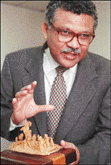
When the Spaniards got to South America they were obsessed with finding El Dorado the mythical city of gold. Along with the gold lust came a number of myths about El Dorado. Colombian Ambassador Alfonso Munera holds a miniature display depicting the legend of the native Chibchas tribe, sailing along the Guatavita Lagoon to dump their gold as a way of honouring the gods.
In conversation with Colombian Ambassador Alfonso Munera
LAST JUNE the housekeeper for the Colombian Ambassador thought she would welcome him to the island with Jamaican style beef, rice and peas and banana.
Instead, she pulled out memories from 30 years ago when Alfonso Munera's grandmother fed her family in much the same way in Cartagena. A Black woman, she cooked with bananas grown along Colombia's Caribbean coast and sparked her dishes with the same sassiness as Jamaicans, says Mr. Munera.
There are many other reasons why Jamaica feels as natural as rice and peas on a Sunday for this journalist turned historian turned diplomat.
Jamaican and Colombian kumina and mento groups are eerily similar and provide proof of how closely linked we were in the past. "You can change economic, political and the international atmosphere but culture is very persistent," says Mr. Munera.
As in Jamaica, Colombia's Caribbean coast has Maroon communities (Palenque) that sing in a similar Bantu language and sway in a manner reminiscent of Jamaican kumina. The fiercely independent Palenques fought against their slave captors and escaped in the bushes along the coast to build their own towns. In the 17th century they signed one of the first treaties signed by Black people in the Americas.
"There are many anecdotes of the close and intimate relationship between Jamaica and Colombia in the 18th, 19th and 20th century," he says.
The most important Colombian and Latin American writer of the 19th century, Jose Isaac, was the son of a Jamaican. Author of the famous La Maria, described by the Ambassador as a cultural monument, his father was one of the pioneers of Colombia's sugar industry.
At the turn of the 19th century daughters of well heeled Colombians were sent to Immaculate and other such schools in Jamaica to study English and round out their education.
"I also have the feeling that they perceived these Jamaican schools as among the best in the region in terms of educating young ladies," says the Ambassador.
The world's fascination with the vivacity of the two countries and the stereotypical view of both as sweltering drug dens also bear a striking similarity.
Yet only a minute fraction of Colombia's 42 million people is involved in the illegal narcotics trade, says Mr. Munera.
The image of his country as a haven for traffickers "is sad because the vast majority are hard working people and they have been known throughout the world as such."
The country, he says, has spent the last 14 to 15 years fighting the illegal trade which has tarnished its reputation and battered the economy due to the loss of foreign investments.
"We have put in so much money from our budget and thousands of Colombian journalists, politicians, security forces have been killed because they fought energetically against drug trafficking."
Recently, he notes, the country destroyed two of the most important drug cartels -- headed by Pablo Escobar and Rodrigues in Cali.
Last year, Colombia also decided to step up its war against drugs on another front. "We decided to tell more frankly to the international community that we were not going to carry (the sole) responsibility (anymore) but wanted the international community to recognise their responsibly."
The message is that this is a global problem, not just Colombia's, says the Ambassador.
"This business is run by an international network of criminals not just Colombians. We want consuming countries, countries that produce the raw material, and the transshipment countries to assume their responsibilities."
Countries like the US, Germany, Spain, Canada, England and others in Latin America and the Caribbean have responded positively in joining the fight against the narcotic trade, he says.
"I think we're at the point of getting more understanding about our tragedy."
Mr. Munera says it also pains him that Colombia has been so prominently branded with the drug label. A not very well-known fact is that the country is the second largest exporter of flowers, its roses are particularly popular. Almost lost in the web of drugs is the enormous strength of the Colombian coffee industry, and other important areas such as banana, textile and petroleum.
The 47-year-old, who intends to return to the history books, says he's optimistic the tides will change soon. His country, he notes, is wonderful for its cities and people who are so similar to people in the Caribbean.
Mr. Munera, who shops for his own vegetables in downtown Kingston's gritty Coronation Market on Thursday afternoons, says these sojourns remind him of how much Jamaicans love life and how hard they fight to keep their happiness. It's also a way of keeping in touch with real people, he reckons.
The Ambassador who, with his wife, daughter and niece, danced his way from Devon House to New Kingston in April's Carnival parade, finds Port Antonio as one of the most beautiful places in the world.
He's also big on Port Royal, which reminds him of Cartagena, and Kingston. Sometimes, he says, he finds a spot overlooking the city "to contemplate the ecological richness of Kingston laid out like the woods (a forest)."
Though there are real problems with crime and violence, Kingston is pleasant (and different from most modern cities) because of all the trees. Even in the poorest neighbourhoods, he notes, people have their own little houses with trees always in the background.
"It's a privilege to see."
Under his watch as Ambassador, he says he wants to promote and strengthen the friendship between Jamaica and Colombia.
"We're not strangers after all."
|












|
||||