|
Monday | June 5, 2000
| ||||||
              |
Barbados wary of new linkages
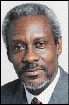
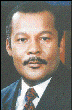
BRIDGETOWN, Barbados, CANA : BARBADIAN PRIME Minister Owen Arthur in an interview with the Sunday Sun newspaper threw some light on his reported dispute with Jamaica's Prime Minister P.J. Patterson.
The differences with his Jamaican counterpart involve a reported lack of prior consultation on the functioning of a South Co-ordinating Commission, that resulted from the South Summit in Cuba in April, and the work of the Community's Regional Negotiating Machinery (RNM).
He told the newspaper that while the dispute with Patterson was not a personal one, it was hard to see what benefits there
would be from the creation of another body that could not be considered as a political, social or economic entity.
"Before we get involved in any new institution, let us be clear as to what functions it will exercise, how it ought to be structured, and how it will fit into the existing milieu of institutions that are serving the Caribbean..." Arthur said.
"...Barbados' position simply is that our support for the creation of a South Comm-ission is
that it (has) not been a matter that has ever engaged our Foreign Affairs Ministers, not been approved by Prime Ministers (sub-committees), nor has it been a decision of the heads of government, and we would want this matter properly appraised before we go head-long into it".
Arthur spoke in the context that Barbados is reviewing its involvement in regional and international institutions.
Arthur, who is also the country's Finance Minister, said that the proposed Caribbean Court of Justice, would also come under the microscope of a comprehensive evaluation being undertaken by his administration.
"The government of Barbados is doing a comprehensive evaluation of the costs and benefits to Barbados of our participation in regional and international institutions," the Sunday Sun quoted Arthur as saying.
"We will not be easily drawn into participating in another international organisation unless we can be assured that such participation will be of great and direct benefits to the taxpayers who have to foot the bill. It has to be worth the effort".
Arthur, noting that some regional institutions were struggling to survive because of financial and other problems, said the region currently faces a situation of "international overload".
He said, too, the Caribbean subscribes to and supports a large number of institutions in and outside the region, including the United Nations, the 71-member African, Caribbean and Pacific (ACP) grouping and the Organisation of American States (OAS).
"The grim facts are that most Caribbean states find it difficult, and sometimes impossible, to carry the full weight of participating effectively in those institutions," the Barbados leader said.
"Recently, the OECS (Organ-isation of Eastern Caribbean States) was the subject of comment regarding the capacity of member states to pay their way. The institutions of CARICOM are languishing for financial contributions from members and the arrears situation has become very stark".
|














|
||||